Introduction
Our brains are amazing meaning-machines. Even when we aren’t consciously guiding them, they actively observe, link, and interpret. But when we skip the act of mindful observation, the mind forms associations automatically — sometimes helpful, often misleading. This article explores how the brain connects dots, why we need to guide that process, and what it means for everyday life.
1. The Brain’s Association Machine
Psychologists often describe two modes of thinking:
The fast, automatic, pattern-driven mode (known as System 1)
and the slower, deliberate, analytical mode (System 2).
System 1 is constantly linking what we see, hear, or feel into quick judgments — “that sound = danger,” “that face = familiar,” “that number = 5.”
System 2, on the other hand, steps in when we consciously pause to analyze: “Wait, is this really correct? What’s the full context?”
Because most of our daily thoughts come from System 1, our brain keeps making small associations without us realizing it.
For example, you might notice while filling in a date that you accidentally type 05 instead of 10 for October, simply because your eyes caught the “2025” written beside it. Your brain, seeing the “5,” linked it automatically to the month field — a quick, subconscious pattern match. These tiny slips are harmless most of the time, but they reveal how strongly our brain’s associative circuits run on autopilot.
This tendency — to fill in blanks, assume connections, and take shortcuts — is the same mechanism behind both our creativity and our cognitive biases. Without mindful guidance, it can just as easily mislead us as it can help us.
2. When Linking Gets Strange: The Alien Hand Example
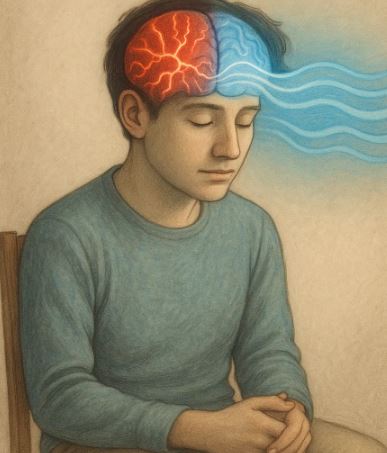
Sometimes, the brain’s linking mechanisms go into extreme territory, showing just how independent parts of the mind can act. In split-brain research — pioneered by researchers such as Michael Gazzaniga under the work of Roger Sperry — patients whose corpus callosum (the bridge between the two hemispheres) has been severed show strange behaviours:
Each hemisphere can form its own perceptions and impulses.
In a classic demonstration, a patient is asked to use the normal working hand to pick a blue ball from a bag containing red and blue.
The “normal” hand does so. The other hand — “alien” to conscious control — grabs a red ball anyway, even though the person asserts they had no idea what that hand was doing.
This shows the mind’s associative machinery working in parallel, outside conscious observation.
In this scenario, the “alien” hand still “knows” the rules (two colours, pick blue), but lacking coordination with conscious intention, it follows its own linkage pattern. This dramatic example underscores: the brain’s dot-connecting doesn’t always wait for our conscious command.
When we don’t guide our mind’s associations, we may be at the mercy of automatic linkings.
Dreams: Free-wheeling Associative Storytelling

Every night when we sleep, our brain shifts into a different mode. The so-called “dream state” allows the mind to take fragments of perceptions, emotions, memories — things we saw but didn’t observe deeply — and weave them into narrative form. Because much of our observational attention during the day is diffuse, the dream mind fills in gaps, forging links in search of meaning.
When we don’t practise mindful observation during waking life — not registering fully what we’re seeing or feeling — we give the brain raw material for free associative linking. The result: vivid dreams, odd narratives, symbolic meanings that the conscious mind later tries to decode.
This is why your earlier thought — “if we don’t guide it mindfully, it will find its own way of perception like dreaming” — makes excellent sense. The mind keeps linking; if you don’t direct it, it will roam.
4. Why Mindfulness Matters
If the mind is constantly linking, then mindfulness becomes the tool for steering those connections rather than blindly riding them. Research shows that mindfulness meditation and similar practices alter the brain’s inherent networks, especially the so-called default mode network (DMN) — the network active when the mind is at rest, wandering, associating without conscious direction.
When the DMN is overactive and unsupervised, our mind may drift into habitual associations, biases, jumping to conclusions, making meaning where none exists. Mindful awareness strengthens executive attention and allows the brain to observe first, link later.
Here’s why that matters:
- Better observation = fewer false links and fewer assumptions.
- Awareness of automatic associations = ability to pause and choose instead of react.
- Mindful linking = aligning perception with reality, not just mental pattern-matching.
In short: Mindfulness turns on your “System 2” more often — giving you more control over what System 1 is connecting.
By training your awareness, you reduce the risk of being led by unnoticed associations, automatic judgments, and hidden patterns.
5. Applying This in Everyday Life
Here are practical tips you can use to cultivate mindful connection:
- Pause before reacting. Notice your immediate link-jump (thought, judgements, associations) and ask: “Is this what I saw? Or what I assumed?”
- Slow down observation. When you type, write, speak — notice the digits, the meanings, the automatic links (as in the 2025-05 example).
- Reflect on your dreams and day-residues. What loose threads are your mind linking overnight or during the day? Awareness of these hidden patterns helps you guide them.
- Practice short mindfulness sessions. Just five minutes of observing your breath or body sensations invites your mind to rest in “seeing” rather than “connecting”. Neuroscience shows this reduces DMN wandering.
- Question default associations. The next time your brain leaps to a conclusion (“That means this”, “That must be…”), ask: “Was I observing first, or connecting first?”
Conclusion
Our brains are wired to connect. That’s part of what makes us intelligent, adaptive, creative. But when we leave that wiring unattended, our minds form associations in the background — sometimes helpful, sometimes misleading. The example of the alien-hand, the simple date-typo, the random dream—all illustrate the power and unpredictability of our brain’s associative intelligence.
Mindfulness is the key that brings the conscious referee into the game. By observing before linking, we give our system better data, more accurate connections, fewer errors. The result: clearer perception, wiser judgment, more mindful living.
In a world full of stimuli, don’t just let your mind connect the dots — guide it.
References & Further Resources
- de Haan, EHF, et al. “Split-Brain: What We Know Now and Why This is Important for Neuropsychology.” PMC, 2020. PMC
- Geschwind, DH. “Alien Hand Syndrome.” Neurology, 1995. American Academy of Neurology
- Kahneman, Daniel. Thinking, Fast and Slow. (See summary on The Decision Lab) The Decision Lab+2Farnam Street+2
- Brewer, JA, et al. “Meditation Experience Is Associated with Differences in Default Mode Network Activity and Connectivity.” PNAS, 2011. PNAS
- Doll, A., et al. “Mindfulness Practice is Associated with Intrinsic Functional Brain Activity.” Frontiers in Human Neuroscience, 2015. Frontiers
- Taylor, VA., et al. “Impact of Meditation Training on the Default Mode Network.” SCAN, 2013. OUP Academic
- More accessible resources:
- The Decision Lab guide to System 1 & System 2 thinking. The Decision Lab
- Mindfulness and Default Mode Network research blog. Mindfulness Association