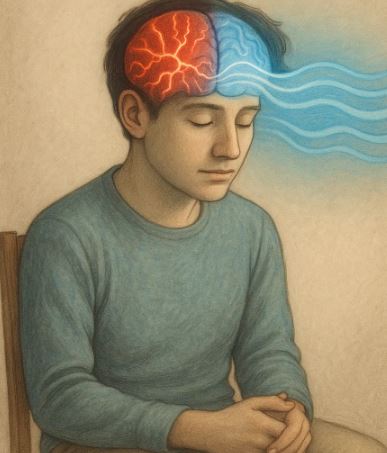
In the last few years, scientists studying Alzheimer’s disease have discovered something fascinating: the brain cleans itself.
Inside every cell, there is a tiny housekeeping system called autophagy. Its job is simple — remove waste, repair damage, and keep the cell healthy.
In 2016, the Nobel Prize was awarded for discovering how this cleaning system works. Since then, researchers have been trying to understand why this system fails in Alzheimer’s disease.
And what they found gives all of us an important lesson about rest, stress, and never-ending work.
What Exactly Is Autophagy?
Autophagy means “self-cleaning”.
Think of your brain cells like a busy home.
Every day, you cook, use dishes, open boxes, unwrap things, and throw away plastic.
If you never clean, the home becomes messy.
Your brain is the same.
Autophagy is the cleaning crew that:
- removes damaged proteins
- sends waste to the right place
- repairs broken parts
- keeps the cell fresh and healthy
Without autophagy, waste piles up — especially in the brain.
What Scientists Found in Alzheimer’s Cells
Researchers noticed something alarming:
In Alzheimer’s brains, there is a huge amount of waste material inside the cells.
But why wasn’t it being cleaned?
That’s when they discovered something important.
Meet mTOR: The Cell’s “Speedometer”
Every cell has a switch called mTOR.
- When mTOR is ON, the cell is in work mode
- When mTOR is OFF, the cell is in cleaning and repair mode
Imagine your brain working nonstop:
- deadlines
- stress
- emotional overload
- lack of sleep
- constant notifications
- no breaks
This keeps mTOR stuck in ON mode.
And when mTOR stays ON all the time, autophagy never happens.
The cleaning crew is never allowed to work.
In Alzheimer’s cells, scientists found that mTOR was running nonstop.
The cells were stressed, hurt, or overworked — and they didn’t know how to rest.
What Happens When a Cell Never Rests
When mTOR stays turned on for too long:
- the cell keeps working, even when tired
- cleaning gets postponed
- waste builds up
- harmful proteins form clumps
- eventually, parts of the brain get damaged
This is exactly what researchers saw in Alzheimer’s patients.
What Happened When Scientists Turned mTOR Off
A scientist in Japan studying Alzheimer’s cell cultures tried something interesting.
He added rapamycin, a molecule known to turn mTOR OFF.
When mTOR turned off:
- the cells immediately slowed down
- autophagy began
- waste was collected
- enzymes moved to the correct places
- the “garbage” inside the cell was cleaned
It was like the brain finally got time to breathe.
This doesn’t mean rapamycin is a cure — it simply proves a deeper truth:
The brain needs downtime to repair.
When we don’t rest, our cells can’t clean themselves.
Our modern lifestyle forces the brain to stay in constant work mode—with back-to-back tasks, stress, screens, late nights, emotional overload, and almost no real breaks. Even when we sit quietly, the mind continues racing.
This nonstop pressure shuts down the body’s natural cleaning and repair system.
Over years, it contributes to burnout, inflammation, memory problems, slower thinking, poor learning, and emotional instability. But when we rest — truly rest — the brain finally gets a chance to activate autophagy, its internal cleaning process.
Simple practices like deep sleep, short pauses, silence, slow breathing, nature walks, or even doing nothing for a few minutes give the brain room to repair itself. Rest isn’t laziness; it is maintenance. For the brain, rest is survival.
Final Note (Important)
Rapamycin is a research molecule.
Human trials for Alzheimer’s treatment using rapamycin are still ongoing, and not yet proven.
This article is not about medicines.
Its intention is simple:
To remind you that rest and breaks are necessary for your brain’s long-term health.
Your brain is capable of amazing things — but only if you give it time to repair itself.