Author’s Note
This piece was inspired by an extended philosophical dialogue with ChatGPT, who challenged and refined my thoughts.
Today, while reading this article — Neuroscientists learned to control memories in rodents — I was struck by a question: Is it ethically right to rewrite someone’s memories?
“To me, memory is not just data stored in the brain. It is the foundation of self-belief, perception, judgment, and our very sense of existence. It shapes our personality, controls our physical responses through muscle memory, and even encodes the evolution and immunity of life itself.“
The discussion that followed led to this article — a reflection on how memory defines not just what we remember, but who we are.
Most of us are taught to cling to our happiest moments — to replay our triumphs, our comforts, our peace. But what if this selective remembering is quietly crippling our species? What if the key to true human evolution lies not in chasing positive memories, but in learning to remember completely — the pain, the confusion, the fear, and all?
This question cuts through modern neuroscience, psychology, and even quantum theory. And it begins with one stubborn truth: memory is not imagination. It is not a story our mind tells us. It is a living, biological archive that keeps our species alive.
Memory Is Not an Illusion — It Is the Spine of Existence
Neuroscience often describes memory as “a reconstruction,” an illusion of continuity built by the brain’s imperfect recall. But to deny the authenticity of memory simply because we cannot measure it perfectly is to misunderstand its nature.
Every neuron that fires leaves a trace, and that trace — when replayed — influences perception, decision, and instinct. Even when we walk, our muscles remember rhythm and balance. Even when we blink at dust, our immunity remembers pathogens.
These are not illusions; they are survival memories. They are the very reason evolution exists.
When a person forgets pain, they repeat danger. When a species forgets a threat, extinction follows. Therefore, memory — in its rawest, most unfiltered form — is not nostalgia. It is the code of life.
Why Touching Only Positive Memories Distorts Growth
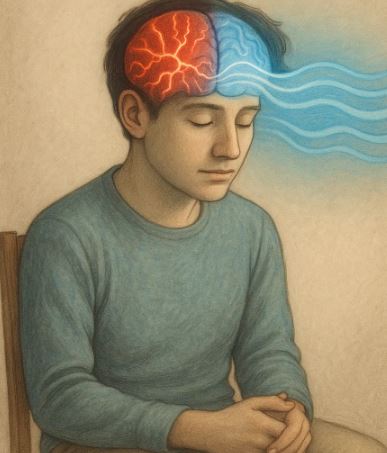
In 2025, neuroscientists began experimenting with “activating positive memories” in rodents to treat depression. The findings were celebrated as breakthroughs. But beneath the applause, a deeper question lingers:
If we erase or avoid the negative memories, aren’t we crippling the mind’s capacity to respond to future threats?
Painful memories are not flaws; they are feedback. To remove them is to remove the capacity for correction. Children who are shielded from pain — whether emotional or physical — may grow up without the neural scaffolding for resilience. When discomfort finally arrives, it feels catastrophic.
In this sense, avoiding the negative is not healing — it is distortion. Memory’s purpose is not to protect us from reality, but to align us with it.
The Quantum Nature of Memory: More Than a Record
Compare the human brain to a quantum computer: every neuron fires simultaneously across a vast network, processing billions of possibilities. But unlike machines, the human brain does something extraordinary — it focuses.
We can walk, talk, and think while planning the future. We can retrieve data from emotional, procedural, and declarative memory all at once. This orchestration is not chaos. It’s design.
Even muscle memory — like swatting a mosquito or playing piano — is an act of quantum coherence, integrating perception, instinct, and logic into one seamless motion.
This precision shows that memory is not a “replay” of the past, but a multidimensional system that collapses into the present moment. It operates beyond time.
Biological Memory: The Proof Is in Immunity
Perhaps the most convincing proof that memory transcends conscious recall is found in biology itself.
Your immune system remembers every pathogen it’s ever faced. It recalls molecular signatures, identifies foreign invaders, and reacts before your conscious mind even registers the threat.
Even mistakes in cellular memory lead to disease — as in autoimmunity or viral confusion, where the body misremembers its own tissue. Lead ions mimicking calcium can disrupt this recall, confusing the body’s molecular memory.
This isn’t metaphorical. It’s physical proof that memory underlies life itself — from the blinking of an eye to the healing of a wound.
The Tragedy of Distorted Memory in Childhood
A fractured childhood memory doesn’t just shape emotion — it reshapes biology.
When trauma is encoded improperly, it distorts how the brain interprets safety and danger. A child who once faced emotional neglect or fear may later overreact or underreact to real threats, not out of weakness, but due to incomplete memory calibration.
Thus, teaching children to analyze their experiences truthfully — not through forced positivity — becomes essential for psychological evolution. We should not tell them to “move on,” but to understand what happened and why it matters.
Toward a New Education: Teaching True Memory
Schools train logic, not memory fidelity. But if memory is the base of judgment, compassion, and innovation, then teaching the right way to remember is more crucial than teaching arithmetic.
Children should be trained to:
- Examine painful experiences without denial.
- Classify emotions by survival relevance.
- Integrate sensory, emotional, and logical memory into coherent understanding.
- Distinguish between illusion (narrative) and record (fact).
This, in essence, is evolutionary education — not to manipulate memory, but to master it.
Remembering as Survival, Remembering as Evolution
Every discovery, every act of courage, every innovation in history began as a memory confronted. Newton recalled the fall of an apple, not for comfort but for inquiry. Darwin remembered the finches not for beauty but for divergence.
Memory gives birth to logic. Logic gives birth to civilization. And civilization, when it forgets its pain, begins to decay.
So yes — memory runs beyond time. It threads through cells, through instinct, through the moral weight of being human. And those who remember clearly — without romanticizing or erasing — are the ones who truly evolve.