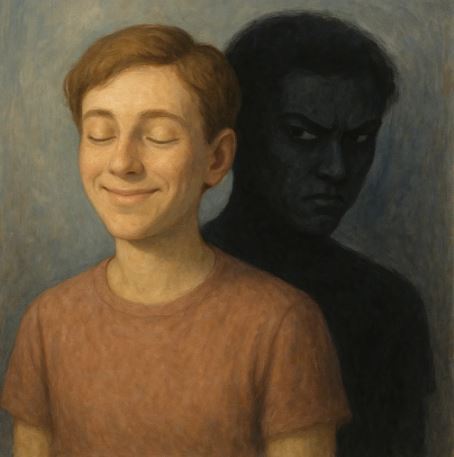
We preserve what we love—but sometimes, what we love imprisons us. Why we cling to what no longer serves us, and how fear masquerades as wisdom when freedom knocks.To value life is sacred. To be shackled by comfort is a self-erasure.
A meditation on the paradox of comfort, the ancient instincts of fear, and the forgotten courage to reclaim our potential.This is a reflection on the invisible forces that bind us—and how to cut the cord.
Whether beggar or baron, every soul labors, not only to acquire but to preserve. What we cling to may differ in form—trophies of affection, accumulated riches, ephemeral accolades, robust health, or the solace of predictable days—but the impulse is the same: to conserve. This impulse, draped in the noble garb of gratitude, may initially be a reverent act—an ode to providence. Yet, when left unexamined, it metamorphoses into a gilded manacle.
Comfort, that beguiling consort, wears two faces. In one light, she elevates; she is the quiet breeze beneath ambition’s wings. But in shadow, she ossifies will and sedates the soul. She becomes a velvet noose—imperceptible, but constricting nonetheless.
The mind, in its primal recesses, is shackled by a limbic logic older than speech—a logic that equates familiarity with safety and equates risk with death. Thus, even when the house is on fire, we may refuse to leave if the floor beneath our feet feels known. This is the fallacy of attachment: we do not merely hold onto things—we allow them to hold us. One begins by seeking sanctuary and ends by becoming a prisoner.
This is why even those entangled in corrosive relationships remain inert. Their departure would require more than courage; it would require the death of an identity long entwined with another’s shadow. When the self has been dimmed to a flicker, the idea of reclaiming one’s own name seems like blasphemy against the past.
It must be stated here, however, that not all attachment is folly. There exists a hallowed form—the attachment to life in extremis. For the one ravaged by disease, or the soldier amid the entropy of war, this attachment is no luxury—it is the spear and shield against obliteration. In such cases, love for life is not weakness but defiance. It is the sacred fuel of resurrection.
But the tragedy lies in misapplication. That same sacred attachment, when transplanted onto illusions of permanence—onto the comforts we mistake for cornerstones—turns against us. It becomes the myth we live by, and the fear we obey. More than actual calamity, it is the idea of calamity—fabricated in the womb of the amygdala—that paralyzes action. The mind, puppeteered by ancestral anxieties, chooses stasis over liberation.
Yet, just beyond the veil of that fear—beyond the province of neurotic anticipation—there lies a greater horizon. Not of fantasy, but of capacity. There exists within each of us a reservoir of puissance that slumbers until summoned. I once read, “One does not discover how much strength one holds until strength becomes the only path left.” How many of us live and die without ever glimpsing the edges of our might?
This is not a plea for constant exertion. Even the most finely tuned engine, capable of blistering speeds, sustains itself through moderation. But to cap that power, to fear its ignition, is to insult the architect of our existence. It is not safety but spiritual entropy that we court in the name of prudence.
One cannot become a navigator of tempests by sheltering forever in the harbor. The self is not made whole by stillness alone but by the rhythm of engagement—by meeting resistance and remembering the musculature of resilience.
Conclusion:
The paradox is simple, though few dare to resolve it: To be free, one must sometimes lose what was never truly theirs. Comfort must be honored, but not enthroned. Attachment must be felt, but not worshiped. And fear—ah, fear must be studied like a language, so that when it whispers its old familiar warnings, we might finally reply with a voice that remembers how to soar.