Many people today live in a constant fight-or-flight state. Stress levels are high, relationships feel fragile, and the body’s natural healing systems stay switched off for long periods.
I recently saw a video that said, “When oxytocin goes up, cortisol goes down.”
This made me wonder: Is one hormone really powerful enough to calm the entire stress system?
The answer is yes.
Oxytocin is one of the most remarkable hormones in the human body.
It influences:
> emotion,
> immunity
> hormones
> pain
> digestion
> memory, and
>even migraines.
And when oxytocin rises, cortisol—the main stress hormone—automatically falls.
This article explains oxytocin in simple language:
what it is, how it works, what increases or reduces it, and how to keep it balanced.
1. What Is Oxytocin?
Oxytocin is often called the “love hormone,” but clinically it is a neurohormone.
This means it acts both as a brain chemical (neurotransmitter) and as a hormone in the bloodstream.
Its functions go far beyond affection. It affects stress, digestion, pain, sleep, empathy, social bonding, and emotional healing.
2. Where Is Oxytocin Produced?
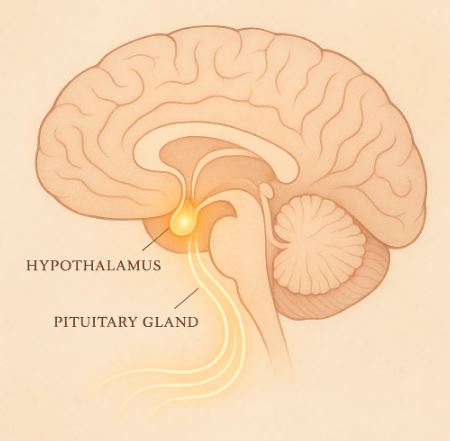
Oxytocin is made in the hypothalamus, a tiny but powerful region deep inside the brain.
It is then stored and released by the posterior pituitary gland, which sits just below the brain.
So oxytocin is essentially:
- designed in the brain,
- delivered through the pituitary,
- spread through the bloodstream and nervous system.
3. When Is Oxytocin Produced?
Oxytocin is released during any moment that creates a feeling of safety, warmth, trust, affection, or connection.
Clinical triggers include:
- Warm touch (hug, hand-holding, gentle massage)
- Petting animals
- Positive social interaction
- Kindness, compassion, emotional bonding
- Deep breathing, meditation
- Warm bath or warm compress
- Soft music, rhythmic sound
- Deep eye contact
- Breastfeeding and childbirth
- Emotional healing moments
- Feeling understood or validated
Even solitude and silence can increase oxytocin if they produce a sense of inner safety.
4. What Are the Main Functions of Oxytocin?
Oxytocin is not just an emotional hormone.Its effects are surprisingly medical and measurable.
A. Reduces cortisol (stress hormone)
This is oxytocin’s strongest effect.
When oxytocin rises:
- heart rate slows
- blood pressure drops
- inflammation reduces
- muscles relax
B. Stabilizes mood and reduces anxiety
Oxytocin calms the amygdala (fear center) of the brain.
C. Improves digestion
It activates the parasympathetic system—the “rest and digest” mode.
D. Strengthens social bonding
Helps with trust, empathy, communication, and emotional connection.
E. Reduces pain
Oxytocin has a natural pain-relief effect.
Studies show it may reduce certain headaches and menstrual pain.
F. Regulates female hormones
Oxytocin interacts with estrogen and improves hormonal balance.
5. What Reduces Oxytocin?
Several modern lifestyle factors lower oxytocin:
- Emotional stress and arguments
- Loneliness with fear (not chosen solitude)
- Sleep deprivation
- High cortisol
- Trauma history
- Harsh or critical environments
- Loud noise
- Overthinking and worry
- Chronic illness
- Inflammatory foods
- Lack of sunlight
When oxytocin falls, people feel:
- tense
- disconnected
- anxious
- irritable
- easily overwhelmed
For some, migraines also worsen when oxytocin drops.
6. Side Effects of Excess or Low Oxytocin
Low Oxytocin Symptoms
- stress and anxiety
- irritability
- hypersensitivity
- feeling unloved or unsafe
- poor digestion
- tension headaches or migraines
- emotional withdrawal
High Oxytocin Symptoms
Oxytocin excess is rare, but when it happens, it can cause:
- emotional dependence
- jealousy
- clinginess
- fear of abandonment
- over-sensitivity to rejection
- strong need for reassurance
Some people with very high oxytocin are deeply loving, but also easily hurt and overly attached.
7. How Does Oxytocin Co-Exist With Other Hormones?
Oxytocin is part of a larger hormonal network.
A. Oxytocin and Cortisol
Opposites.
When one goes up, the other goes down.
B. Oxytocin and Estrogen
Work together.
Estrogen increases oxytocin sensitivity.
This is why many women feel calmer during certain parts of their cycle.
C. Oxytocin and Progesterone
Progesterone can reduce oxytocin’s effects, especially in the premenstrual phase.
D. Oxytocin and DHT
High cortisol or stress can increase androgens like DHT, which may affect mood, irritability, and migraine risk.
E. Oxytocin and Serotonin/Dopamine
All three together create well-being, pleasure, motivation, and emotional stability.
8. Activities That Increase Oxytocin
You don’t need large social circles or relationships to boost oxytocin.
Many of the strongest oxytocin triggers come from simple daily habits.
A. Physical Activities
- Warm shower or bath
- Gentle yoga
- Deep breathing
- Warm compress on chest or stomach
B. Emotional Activities
- Writing or journaling
- Practicing gratitude
- Mindful silence
- Meditation
- Listening to soft music
C. Connection-Based Activities
- Playing with animals
- Hugging someone or even hugging a pillow
- Helping someone
- Meaningful conversation
- Acts of kindness
D. Sensory Activities
- Aromatherapy (lavender, jasmine, sandalwood)
- Soft blankets, warm clothing
- Holding a warm cup of tea
These activities directly activate the parasympathetic system and raise oxytocin naturally.
Conclusion
Oxytocin is far more than a “love hormone.”
It is a biological antidote to stress, a hormone that brings your body out of fight-or-flight and into stability, clarity, and emotional balance. It protects the brain, reduces cortisol, lowers migraine risk, improves digestion, and enhances well-being.
Understanding and balancing oxytocin is especially important in a world where stress is constant and emotional support is not always available.
By practicing simple daily habits—warmth, calmness, kindness, silence, touch, and connection—you can activate oxytocin naturally and protect your mental and physical health for years to come.
You may also like our other article:Histamine: The Hidden Chemical Behind Allergies, Migraines, Anxiety & Sleep Problems