For years, doctors have been trying to control cancer mainly with medicines, but honestly, nothing has been able to stop it completely. That’s what pushed scientists and doctors to look deeper and ask a bigger question — what’s really going wrong inside our cells?
In the last 10–15 years, they started seeing cancer in a different way. Instead of looking only at damaged genes, they noticed something else: “cancer cells behave very differently when it comes to energy.”
That’s where mitochondria also called “the powerhouse of a cell” come in — it is the tiny parts inside our cells that produce energy. And now mitochondria has moved to the center of cancer research.
So let’s dive into what they’ve found.
First Of All What Are Mitochondria — And Why Should We Care?
Mitochondria do far more than just producing energy.
When we say mitochondria are the powerhouse, we simply mean this: they make the energy that keeps the cell alive and working. Just like a power plant supplies electricity to a city, mitochondria supply energy to the cell. Every time your heart beats, you think, digest food, heal a wound, or even blink—mitochondria are providing the fuel for it.
But alongsde they also:
- decide which cells should live or die
- control how much stress a cell can handle
- manage the balance between damage and repair
- influence inflammation
- play a role in immunity and detoxification
When they are strong, the cell runs smoothly.
When they are weak, the entire system becomes unstable.
How Weak Mitochondria Can Lead to Cancer & What Cause The Damage
Mitochondria get damaged mainly because of as you can guess: how we live today.
Constant stress, poor food choices, lack of rest, and exposure to toxins slowly weaken these energy units inside our cells.
Over time, damaged mitochondria produce less energy and more waste, making it harder for the body to repair itself and stay healthy.
Common things that damage mitochondria:
- Chronic stress and long working hours
- Poor diet (excess sugar, processed foods, low nutrients)
- Lack of sleep or irregular sleep cycles
- Sitting too much and lack of physical activity
- Pollution, smoking, and environmental toxins
- Repeated infections and ongoing inflammation
Many researchers now believe that cancer begins long before a tumor forms — it begins when cells start producing energy inefficiently.
Here’s the process:
1. When weak mitochondria cannot make energy normally
The cell “switches” to a backup, emergency energy method called fermentation.
2. This shift is the famous “Warburg Effect”
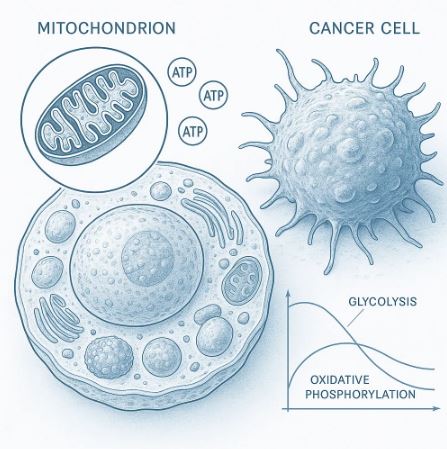
Cancer cells love sugar and create energy without using oxygen.
So, how does it works?
Normally, healthy cells use oxygen inside mitochondria to make energy. This method is slow but clean and efficient, and it keeps cell growth under control.
Cancer cells, however, switch to a different shortcut. Instead of using oxygen properly, they start breaking down large amounts of sugar very quickly to make energy. This is known as the Warburg Effect.
This sugar-based energy method gives cancer cells fast fuel, but it’s inefficient. It creates a lot of waste, damages the surrounding environment, and pushes cells to divide rapidly. That’s why cancer cells consume so much sugar and grow out of control.
This method is fast, but messy — it produces waste and fuels rapid cell growth.
2.1 Why do cancer cells choose this shortcut?
Cancer cells are under constant stress. Their mitochondria are often damaged, so they can’t make energy properly using oxygen. Instead of fixing the problem, cancer cells take an easier route.
They switch to a fast sugar-burning method because:
- It helps cancer cells survive in low-oxygen environments
- It gives quick energy, even if it’s inefficient
- It works without relying on damaged mitochondria
- It supports rapid growth and division
3. Damaged cells are supposed to die — but weak mitochondria can’t trigger their death
Normally,it is the job of mitochondria to tell a damaged cell to self-destruct
If this system fails, faulty cells remain alive and can multiply.
4. Weak mitochondria create too many harmful molecules (free radicals)
These free radicals damage DNA and create mutations — the early seeds of cancer.
5. Over time, the cell’s environment becomes toxic
Low oxygen, inflammation, and chemical waste make it easier for a tumor to form.
So when people say:
“If your mitochondria are strong, you don’t get cancer,
What they mean is:
Healthy mitochondria keep the internal environment stable and prevent many early cancer steps.
But it’s not a 100% guarantee — it simply reduces the chances significantly.
Why This Explanation Matters Today
In modern life, almost everything weakens mitochondria:
- high sugar diets
- processed seed oils
- stress and anxiety
- less sleep
- pollution
- chemicals in food
- chronic inflammation
- lack of physical activity
This is why we are seeing more fatigue, hormonal imbalance, digestive disorders, autoimmune issues, brain fog — and yes, higher cancer rates.
The environmental pressure on our mitochondria has increased dramatically compared to previous generations.
How to Strengthen Mitochondria (Beginner-Friendly Habits)
These are science-supported steps:
1. Keep blood sugar stable
- avoid frequent sugary snacks
- pair carbs with protein or healthy fats
- reduce junk and ultra-processed foods
Stable blood sugar = less stress on mitochondria.
2. Move more, even lightly
You don’t need heavy workouts.
Daily walking, stretching, climbing stairs — all signal the body to create new mitochondria.
3. Prioritize sleep
Deep sleep is when the body repairs damaged mitochondria.
4. Eat foods rich in mitochondrial nutrients
This includes:
- eggs (choline)
- nuts + seeds
- fish
- leafy greens
- berries
- magnesium-rich foods
- B12 and folate-rich foods
- omega-3 fatty acids
5. Reduce toxin exposure
Your mitochondria hate:
- smoking
- excess alcohol
- air pollution
- pesticides
- certain industrial seed oils
6. Manage chronic stress
Long-term stress stiffens mitochondrial membranes and weakens energy production.
Breathing exercises, nature walks, rituals, simple routines — all help.
Conclusion
Mitochondria are not a magic shield that guarantees a cancer-free life.
But they are the early warning system, the first line of defence, and the core energy source that keeps cells healthy.
If they remain strong, many harmful processes — oxidative stress, inflammation, DNA damage, abnormal growth — stay under control.In today’s world, supporting mitochondrial health isn’t just good science;
it’s a practical strategy for long-term wellbeing and cancer prevention.