(And How to Use Them Safely Without Damaging Your Skin Barrier)
No matter which skincare product you pick up—serum, toner, ampoule, or cream—it will almost always contain one or more of a few essential “active” ingredients. Understanding these ingredients helps you instantly guess why that product exists and whether your skin really needs it.
Below are the five most common actives used across global skincare, the reason they’re added, how to use them correctly, and what to avoid.
1. Hyaluronic Acid (HA): The Deep Hydrator
Hyaluronic acid is not an exfoliating acid. Instead, it is a powerful humectant that draws water into the skin, making it look plump, fresh, and moisturized. Products that mention “water serum,” “hydration booster,” or “plumping effect” almost always rely on HA. It suits all skin types, especially dehydrated or tired-looking skin.
How to understand a product immediately:
If a product says “hydrating,” “plumping,” “water serum,” or “moisture booster,” it likely contains HA.
Best for:
-Dry or dehydrated skin
-Dull, tired-looking skin
-All skin types (safe even for sensitive users)
Benefits: deep hydration, smoother texture, plumpness
Possible issues: can dry out skin if used without moisturizer
How to use:
- Apply on slightly damp skin
- Seal it with a moisturizer
- Avoid using it alone on very dry skin
2. Salicylic Acid (BHA): The Pore Cleaner
Salicylic acid is an oil-soluble exfoliant that penetrates deep into pores, dissolves oil, and clears blackheads. If a product claims “pore clearing,” “acne control,” or “blackhead removal,” it probably contains BHA. It works best for oily, acne-prone, or textured skin.
Why it’s added:
Salicylic acid is oil-soluble, which means it travels deep inside clogged pores, dissolves oil, and reduces acne.
How to understand a product immediately:
If it mentions “pore clearing,” “blackhead removal,” or “acne treatment,” it likely uses BHA.
Best for:
-Acne-prone skin
-Oily or textured skin
-Blackheads/whiteheads
Benefits: fewer breakouts, clearer pores, smoother skin
Possible issues: dryness or irritation with overuse
How to use:
- Start with 1–2 times a week
- Apply on clean, dry skin
- Follow with moisturizer
- Use gentle formulas like Cosrx BHA Blackhead Power Liquid
3. Glycolic Acid (AHA): The Glow Giver
Glycolic acid is one of the most effective AHAs for brightening dull skin, improving texture, and reducing early signs of aging. Its small molecular size helps it penetrate deeper, which makes it powerful but slightly intense. Products that say “glow,” “radiance,” or “resurfacing” commonly contain glycolic acid.
How to understand a product immediately:
Anything claiming “glow,” “radiance,” “brightening peel,” or “resurfacing” usually contains glycolic acid.
Best for:
-Pigmentation
-Uneven texture
-Dull skin
-Early signs of aging
Benefits: Clearer skin, glow, fading dark spots
Possible issues: Can irritate sensitive skin if overused
How to use:
- Begin with 5–10% concentration
- Apply 1–2 nights a week
- Always wear sunscreen the next day
4. Lactic Acid (AHA): The Gentle Exfoliator
Lactic acid works like glycolic acid but is milder and more hydrating. It is ideal for beginners or anyone with sensitive skin who still wants gentle exfoliation. If a label says “mild AHA,” “skin renewal,” or “gentle exfoliation,” it will often contain lactic acid.
Why it’s added:
Lactic acid exfoliates like glycolic but is softer, more hydrating, and kinder to sensitive skin.
How to understand a product immediately:
If something says “gentle exfoliation,” “renewal,” or “mild AHA,” it is probably lactic acid.
Best for:
-Beginners
-Sensitive skin
-Dry skin
-Mild texture issues
Benefits: Smoothness, brightness, hydration
Possible issues: Mild stinging for extremely sensitive users
How to use:
- Use every other night if your skin tolerates it
- Pair with sunscreen during the day
5. Ascorbic Acid (Vitamin C): The Brightener
Vitamin C is a powerful antioxidant that fades dark spots, brightens the skin, and boosts collagen production. Products that mention “brightening serum,” “anti-dark spot,” or “glow booster” usually depend on this ingredient. It helps with sun damage, dullness, and uneven tone.
Why it’s added:
Vitamin C is a powerful antioxidant that brightens skin, fades pigmentation, and boosts collagen.
How to understand a product immediately:
Words like “brightening serum,” “anti-dark spot,” or “glow booster” usually indicate Vitamin C.
Best for:
Dark spots
Sun damage
Dullness
Uneven skin tone
How to use:
- Apply in the morning
- Start with 10–15%
- Always pair with sunscreen
Mixing & Safety Rules for Acids
Using these acids correctly is as important as choosing the right one.
Avoid mixing:
- Vitamin C with AHAs/BHAs (unless your skin is very experienced)
Always:
- Moisturize after exfoliating acids
- Wear sunscreen daily
- Pause acids if you experience redness, burning, or sensitivity
For barrier repair:
- Use ceramides
- Centella asiatica
- Snail mucin
A Gentle Korean-Inspired Routine to Heal & Glow
Cleansing
Use micellar water or cleansing oil first to reduce exposure to hard tap water. Rinse your face with filtered water when possible. If your skin is irritated, try a no-rinse routine a few days a week.
Hydration
Use a calming toner with ingredients like Centella or green tea. Follow with snail mucin or rice extract for nourishment and deeper hydration.
Simple Daily Radiant Skin Routine
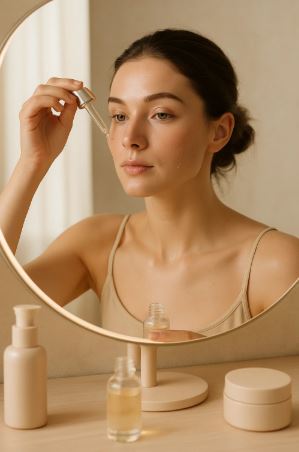
Morning:
- Gentle cleanser
- Vitamin C serum
- Moisturizer
- SPF 50
Night:
- Cleanser
- Hydrating toner
- One active (HA daily; BHA weekly; Lactic/Glycolic 2–3x/week)
- Moisturizer
- Snail mucin or rice serum if needed